Django Under Hood 08: Django’s Static Files - From collectstatic to Browser Cache

Part 8 of the “Django Under the Hood ” series — deep dives into Django’s internals, edge cases, and the mechanics that separate production-grade applications from tutorial code.
~] python manage.py collectstatic
This command copies files. That’s what most developers think.
It actually does much more: finds files across multiple locations, resolves naming conflicts, optionally hashes filenames for cache busting, compresses assets, and builds a manifest mapping original names to processed names.
Then there’s serving. Development uses Django’s static view. Production uses… what exactly? Nginx? WhiteNoise? A CDN? Each has different performance characteristics, different caching behaviors, different security implications.
Most Django applications have misconfigured static files. They work, but they’re slow, or they break on deploy, or they don’t cache properly. Understanding the staticfiles system prevents these issues.
Let’s trace a static file from your static/ directory to a browser's cache.
The Static Files App
# settings.py
INSTALLED_APPS = [
    'django.contrib.staticfiles',
    # ...
]
This app provides:
- The
{% static %}template tag - The
collectstaticmanagement command - Finders that locate static files
- Storage backends that process and serve files
Configuration:
# Where collectstatic puts files
STATIC_ROOT = BASE_DIR / 'staticfiles'

# URL prefix for static files
STATIC_URL = '/static/'

# Additional directories to search (beyond app static/ folders)
STATICFILES_DIRS = [
    BASE_DIR / 'static',
]

# How files are found
STATICFILES_FINDERS = [
    'django.contrib.staticfiles.finders.FileSystemFinder',
    'django.contrib.staticfiles.finders.AppDirectoriesFinder',
]
Finders: Locating Static Files
When Django needs a static file, it asks finders:
from django.contrib.staticfiles import finders

# Find a file
path = finders.find('js/app.js')
# Returns: '/path/to/project/static/js/app.js'

# Find all matches (if file exists in multiple locations)
paths = finders.find('js/app.js', all=True)
# Returns: ['/path/to/project/static/js/app.js', '/path/to/app/static/js/app.js']
FileSystemFinder
Searches STATICFILES_DIRS:
# django/contrib/staticfiles/finders.py
class FileSystemFinder(BaseFinder):
    def __init__(self, app_names=None, *args, **kwargs):
        self.locations = []
        for root in settings.STATICFILES_DIRS:
            if isinstance(root, (list, tuple)):
                prefix, root = root
            else:
                prefix = ''
            self.locations.append((prefix, root))

    def find(self, path, all=False):
        matches = []
        for prefix, root in self.locations:
            if prefix:
                if not path.startswith(prefix):
                    continue
                path = path[len(prefix):]

            full_path = os.path.join(root, path)
            if os.path.exists(full_path):
                if not all:
                    return full_path
                matches.append(full_path)

        return matches
AppDirectoriesFinder
Searches static/ subdirectories in each installed app:
class AppDirectoriesFinder(BaseFinder):
    def __init__(self, app_names=None, *args, **kwargs):
        self.apps = []
        for app_config in apps.get_app_configs():
            static_dir = os.path.join(app_config.path, 'static')
            if os.path.isdir(static_dir):
                self.apps.append(app_config.name)
                self.storages[app_config.name] = FileSystemStorage(location=static_dir)
Order matters: First finder to return a path wins. If you have project/static/js/app.js and myapp/static/js/app.js, FileSystemFinder (listed first) returns the project-level file.
collectstatic: The Build Step
~] python manage.py collectstatic
What actually happens:
# django/contrib/staticfiles/management/commands/collectstatic.py
class Command(BaseCommand):
    def handle(self, **options):
        self.storage = staticfiles_storage  # Usually StaticFilesStorage

        for finder in get_finders():
            for path, storage in finder.list(ignore_patterns):
                # Get source path
                source_path = storage.path(path)

                # Destination in STATIC_ROOT
                dest_path = self.storage.path(path)

                # Copy (or process)
                self.copy_file(source_path, dest_path)
File Processing Pipeline
With ManifestStaticFilesStorage:
STATICFILES_STORAGE = 'django.contrib.staticfiles.storage.ManifestStaticFilesStorage'
The pipeline:
- Collect: Copy files to
STATIC_ROOT - Hash: Calculate content hash for each file
- Rename: Copy to hashed filename (
app.js→app.abc123.js) - Rewrite: Update references in CSS/JS files
- Manifest: Write
staticfiles.jsonmapping original → hashed names
# django/contrib/staticfiles/storage.py
class ManifestStaticFilesStorage(ManifestFilesMixin, StaticFilesStorage):
    manifest_name = 'staticfiles.json'

    def post_process(self, paths, dry_run=False, **options):
        # Process files in dependency order
        for name, hashed_name, processed in self._post_process(paths, ...):
            yield name, hashed_name, processed

    def hashed_name(self, name, content=None):
        # Calculate hash from content
        if content is None:
            content = self.open(name)

        md5 = hashlib.md5()
        for chunk in content.chunks():
            md5.update(chunk)

        file_hash = md5.hexdigest()[:12]

        # Insert hash before extension
        root, ext = os.path.splitext(name)
        return f'{root}.{file_hash}{ext}'
The Manifest File
// staticfiles/staticfiles.json
{
    "paths": {
        "js/app.js": "js/app.d41d8cd98f00.js",
        "css/style.css": "css/style.5eb63bbbe01e.css",
        "img/logo.png": "img/logo.098f6bcd4621.png"
    },
    "version": "1.0"
}
CSS URL Rewriting
References in CSS files get updated:
/* Before: style.css */
.logo {
    background: url('../img/logo.png');
}

/* After: style.5eb63bbbe01e.css */
.logo {
    background: url('../img/logo.098f6bcd4621.png');
}
class HashedFilesMixin:
    patterns = (
        ("*.css", (
            r"url\((['\"]?)(.+?)\1\)",  # url('...')
            r"@import\s+(['\"])(.+?)\1",  # @import '...'
        )),
    )

    def url_converter(self, name, hashed_files, template=None):
        def converter(matchobj):
            url = matchobj.group(2)
            # Resolve relative URL
            url_path = posixpath.join(posixpath.dirname(name), url)
            # Look up hashed name
            hashed_url = hashed_files.get(url_path, url)
            return template % hashed_url
        return converter
The static Template Tag
{% load static %}
<script src="{% static 'js/app.js' %}"></script>
What it returns depends on storage:
# django/templatetags/static.py
@register.simple_tag
def static(path):
    return staticfiles_storage.url(path)
Without Manifest (Development)
class StaticFilesStorage(FileSystemStorage):
    def url(self, name):
        return urljoin(self.base_url, name)
        # Returns: '/static/js/app.js'
With Manifest (Production)
class ManifestStaticFilesStorage:
    def url(self, name):
        # Look up in manifest
        hashed_name = self.stored_name(name)
        return urljoin(self.base_url, hashed_name)
        # Returns: '/static/js/app.d41d8cd98f00.js'

    def stored_name(self, name):
        # Load manifest if not cached
        if self.manifest is None:
            self.load_manifest()

        return self.manifest.get(name, name)
Key insight: The template tag doesn’t change, but output changes based on storage backend.
Development: Django’s Static View
# urls.py
from django.conf import settings
from django.conf.urls.static import static

urlpatterns = [
    # ...
] + static(settings.STATIC_URL, document_root=settings.STATIC_ROOT)
But that only serves from STATIC_ROOT. During development, files aren't collected yet. Django provides a different view:
# With DEBUG=True, staticfiles app adds this automatically
from django.contrib.staticfiles.views import serve

def serve(request, path, insecure=False, **kwargs):
    # Use finders to locate the file
    normalized_path = posixpath.normpath(path).lstrip('/')
    absolute_path = finders.find(normalized_path)

    if not absolute_path:
        raise Http404

    # Serve directly
    return FileResponse(open(absolute_path, 'rb'))
Important: This bypasses STATIC_ROOT entirely. Files are served directly from their source locations using finders.
Production: The Options
Option 1: Reverse Proxy (Nginx)
server {
    location /static/ {
        alias /path/to/staticfiles/;
        expires 1y;
        add_header Cache-Control "public, immutable";
    }

    location / {
        proxy_pass http://django:8000;
    }
}
Pros: Fast, battle-tested, handles range requests Cons: Separate process, configuration outside Django
Option 2: WhiteNoise
~] pip install whitenoise
# settings.py
MIDDLEWARE = [
    'django.middleware.security.SecurityMiddleware',
    'whitenoise.middleware.WhiteNoiseMiddleware',  # After SecurityMiddleware
    # ...
]

STATICFILES_STORAGE = 'whitenoise.storage.CompressedManifestStaticFilesStorage'
WhiteNoise serves static files directly from Django.
Option 3: CDN
STATIC_URL = 'https://cdn.example.com/static/'
Files are still collected locally, but URLs point to CDN. You sync STATIC_ROOT to CDN during deploy.
WhiteNoise: Deep Dive
WhiteNoise is fascinating because it makes Python competitive with Nginx for static file serving. How?
Middleware Architecture
# whitenoise/middleware.py
class WhiteNoiseMiddleware:
    def __init__(self, get_response):
        self.get_response = get_response
        self.static_prefix = settings.STATIC_URL

        # Pre-load all static files at startup
        self.files = {}
        self.load_static_files()

    def __call__(self, request):
        if self.is_static_file(request.path):
            return self.serve_static(request)
        return self.get_response(request)

    def load_static_files(self):
        # Walk STATIC_ROOT, load file metadata
        for root, dirs, files in os.walk(settings.STATIC_ROOT):
            for filename in files:
                path = os.path.join(root, filename)
                url_path = os.path.relpath(path, settings.STATIC_ROOT)
                self.files[url_path] = StaticFile(path)
Startup loading: All file metadata is loaded when Django starts. No filesystem calls during requests.
StaticFile: Precomputed Everything
class StaticFile:
    def __init__(self, path):
        self.path = path

        # Read file once
        with open(path, 'rb') as f:
            self.content = f.read()

        # Precompute headers
        self.stat = os.stat(path)
        self.etag = self.compute_etag()
        self.last_modified = http_date(self.stat.st_mtime)
        self.content_length = len(self.content)

        # Precompute compressed versions
        self.gzip_content = self.compress_gzip()
        self.brotli_content = self.compress_brotli()

    def compute_etag(self):
        return hashlib.md5(self.content).hexdigest()
Serving a Request
def serve_static(self, request):
    static_file = self.files.get(request.path.lstrip('/'))

    if not static_file:
        return self.get_response(request)  # Pass to Django

    # Check If-None-Match (ETag)
    if request.headers.get('If-None-Match') == static_file.etag:
        return HttpResponse(status=304)  # Not Modified

    # Check If-Modified-Since
    if request.headers.get('If-Modified-Since') == static_file.last_modified:
        return HttpResponse(status=304)

    # Select content based on Accept-Encoding
    if 'br' in request.headers.get('Accept-Encoding', ''):
        content = static_file.brotli_content
        encoding = 'br'
    elif 'gzip' in request.headers.get('Accept-Encoding', ''):
        content = static_file.gzip_content
        encoding = 'gzip'
    else:
        content = static_file.content
        encoding = None

    response = HttpResponse(content)
    response['Content-Length'] = len(content)
    response['ETag'] = static_file.etag
    response['Cache-Control'] = 'public, max-age=31536000, immutable'

    if encoding:
        response['Content-Encoding'] = encoding

    return response
Why WhiteNoise Is Fast
- No filesystem I/O: Files loaded at startup, served from memory
- Precomputed headers: ETag, Last-Modified calculated once
- Pre-compressed: Gzip/Brotli done at startup, not per-request
- 304 responses: Conditional requests skip body entirely
- Immutable caching: Hashed filenames enable infinite caching
CompressedManifestStaticFilesStorage
# whitenoise/storage.py
class CompressedManifestStaticFilesStorage(
    CompressedFilesMixin,
    ManifestStaticFilesStorage
):
    pass

class CompressedFilesMixin:
    def post_process(self, paths, **options):
        # Run parent post_process (hashing)
        for name, hashed_name, processed in super().post_process(paths, **options):
            yield name, hashed_name, processed

        # Compress each file
        for path in paths:
            full_path = self.path(path)

            # Create .gz version
            with open(full_path, 'rb') as f_in:
                with gzip.open(f'{full_path}.gz', 'wb') as f_out:
                    f_out.write(f_in.read())

            # Create .br version (if brotli installed)
            if brotli:
                with open(full_path, 'rb') as f_in:
                    with open(f'{full_path}.br', 'wb') as f_out:
                        f_out.write(brotli.compress(f_in.read()))
After collectstatic:
staticfiles/
├── js/
│   ├── app.d41d8cd98f00.js
│   ├── app.d41d8cd98f00.js.gz
│   └── app.d41d8cd98f00.js.br
├── css/
│   ├── style.5eb63bbbe01e.css
│   ├── style.5eb63bbbe01e.css.gz
│   └── style.5eb63bbbe01e.css.br
Cache Headers: Getting Them Right
Without Manifest (Bad)
Cache-Control: max-age=0
Every page load re-fetches every static file.
With Manifest (Good)
Cache-Control: public, max-age=31536000, immutable
public: CDNs can cachemax-age=31536000: Cache for 1 yearimmutable: Don't even revalidate
This works because filenames change when content changes. app.abc123.js is a different URL than app.def456.js.
Versioned URLs Alternative
If you can’t use manifest storage:
# settings.py
import time
STATIC_VERSION = str(int(time.time()))

# template
<script src="{% static 'js/app.js' %}?v={{ STATIC_VERSION }}"></script>
Less elegant, but works.
Common Issues
Issue 1: Static Files 404 in Production
Cause: collectstatic not run, or STATIC_ROOT not served.
# Run collectstatic
~] python manage.py collectstatic --noinput

# Verify files exist
~] ls -la staticfiles/
Issue 2: Old Files Cached After Deploy
Cause: Not using manifest storage, or CDN not purged.
Fix: Use ManifestStaticFilesStorage — new deploys get new hashes.
Issue 3: CSS url() References Broken
Cause: Relative paths in CSS don’t match after hashing.
Fix: Manifest storage rewrites URLs. Ensure paths are correct relative to CSS file location.
Issue 4: collectstatic Slow
Cause: Processing thousands of files.
# Only collect changed files
~] python manage.py collectstatic --noinput --ignore=*.map

# Use parallel processing (Django 4.2+)
~] python manage.py collectstatic --noinput
Issue 5: ManifestStaticFilesStorage Error on Missing File
ValueError: Missing staticfiles manifest entry for 'js/missing.js'
Cause: Template references file that wasn’t collected.
Fix: Ensure file exists, or use ManifestStaticFilesStorage with manifest_strict = False:
class ForgivingManifestStorage(ManifestStaticFilesStorage):
    manifest_strict = False
Performance Comparison
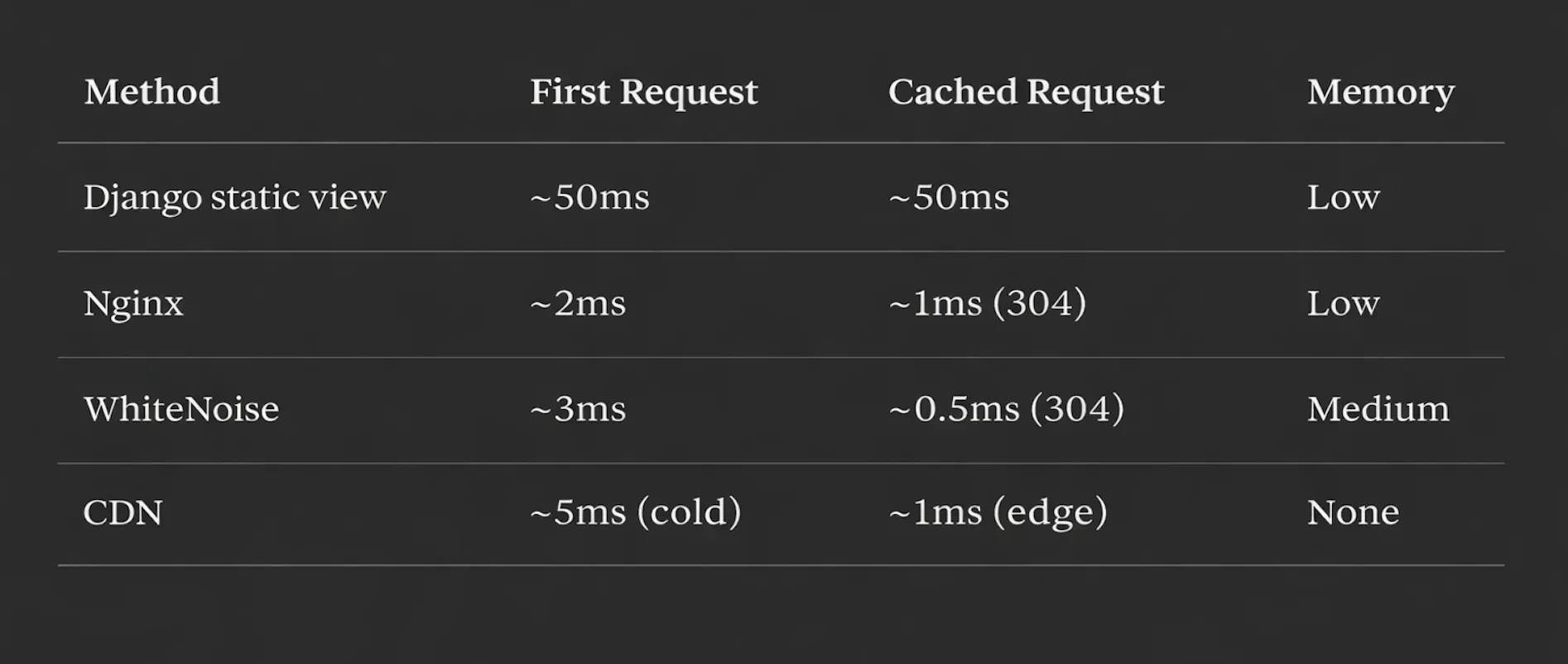
WhiteNoise is ~95% as fast as Nginx while being much simpler to configure.
What’s Next
This was static files — from finders to browser cache.
Next in the series: Migration System Deep Dive — how Django detects model changes, generates migration operations, and applies them to databases.
Series: Django Under the Hood
- Request Lifecycle
- ORM Query Compiler
- Connection Management
- Signal Dispatch
- Template Engine
- Form Pipeline
- Authentication Chain
- Static Files and WhiteNoise Internals ← You are here
- Migration System
- Test Client