Django Under Hood 06: Django’s Form Pipeline - From POST Data to Validated Python Objects

Part 6 of the “Django Under the Hood ” series — deep dives into Django’s internals, edge cases, and the mechanics that separate production-grade applications from tutorial code.
if form.is_valid():
    form.save()
Two lines. Fourteen steps.
Between request.POST and a saved database record, Django executes a precise sequence of operations: binding data, coercing types, running validators, checking constraints, cleaning fields, and cross-field validation.
Most developers learn “call is_valid(), check errors, call save()." That's enough for basic forms. But when validation behaves unexpectedly — when clean_fieldname doesn't run, when errors appear on the wrong field, when cleaned_data is missing keys — understanding the pipeline is the only way to debug it.
Let’s trace a form submission from raw POST bytes to validated Python objects.
The Form Class Hierarchy
class ContactForm(forms.Form):
    name = forms.CharField(max_length=100)
    email = forms.EmailField()
    message = forms.CharField(widget=forms.Textarea)
This inherits from:
ContactForm
    └── Form
        └── BaseForm
            └── RenderableFormMixin
The real logic lives in BaseForm:
# django/forms/forms.py
class BaseForm(RenderableFormMixin):
    def __init__(self, data=None, files=None, ...):
        self.data = data or {}
        self.files = files or {}
        self.is_bound = data is not None or files is not None
        self._errors = None  # Cached validation errors
        self._cleaned_data = None  # Not set until validation
Key concept: A form is bound when it receives data. Unbound forms render empty fields. Bound forms validate and show errors.
# Unbound - for displaying empty form
form = ContactForm()

# Bound - for processing submission
form = ContactForm(data=request.POST)
Field Declaration: Metaclass Magic
How does Django know what fields exist?
class ContactForm(forms.Form):
    name = forms.CharField()
    email = forms.EmailField()
The Form class uses a metaclass that collects field declarations:
# django/forms/forms.py
class DeclarativeFieldsMetaclass(MediaDefiningClass):
    def __new__(mcs, name, bases, attrs):
        # Collect fields from class attributes
        declared_fields = {}

        for key, value in list(attrs.items()):
            if isinstance(value, Field):
                declared_fields[key] = value
                attrs.pop(key)  # Remove from class

        # Inherit fields from parent classes
        for base in bases:
            if hasattr(base, 'declared_fields'):
                declared_fields = {**base.declared_fields, **declared_fields}

        new_class = super().__new__(mcs, name, bases, attrs)
        new_class.declared_fields = declared_fields

        return new_class
At class creation time, fields move from class attributes to declared_fields:
ContactForm.declared_fields
# {'name': <CharField>, 'email': <EmailField>, 'message': <CharField>}
Each form instance gets its own copy:
def __init__(self, ...):
    self.fields = copy.deepcopy(self.declared_fields)
This allows per-instance field modification:
form = ContactForm()
form.fields['email'].required = False  # Only affects this instance
The Validation Pipeline: 14 Steps
When you call form.is_valid():
# django/forms/forms.py
def is_valid(self):
    return self.is_bound and not self.errors

@property
def errors(self):
    if self._errors is None:
        self.full_clean()  # The validation pipeline
    return self._errors
full_clean() orchestrates everything:
def full_clean(self):
    self._errors = ErrorDict()

    if not self.is_bound:
        return  # Nothing to validate

    self._clean_fields()    # Steps 1-8 (per field)
    self._clean_form()      # Steps 9-12 (cross-field)
    self._post_clean()      # Steps 13-14 (ModelForm hook)
Steps 1–8: Field Cleaning (_clean_fields)
def _clean_fields(self):
    for name, field in self.fields.items():
        # Step 1: Get raw value from data
        value = self._field_data_value(field, self.add_prefix(name))

        try:
            # Step 2: Check if empty and required
            if value in field.empty_values:
                if field.required:
                    raise ValidationError(field.error_messages['required'])
                continue  # Skip remaining validation

            # Step 3: Call field.to_python() - type coercion
            value = field.to_python(value)

            # Step 4: Call field.validate() - field-specific validation
            field.validate(value)

            # Step 5: Call field.run_validators() - run validators list
            field.run_validators(value)

            # Step 6: Store in cleaned_data
            self.cleaned_data[name] = value

            # Step 7: Call clean_<fieldname>() if it exists
            if hasattr(self, f'clean_{name}'):
                # Step 8: Replace value with method's return
                value = getattr(self, f'clean_{name}')()
                self.cleaned_data[name] = value

        except ValidationError as e:
            self.add_error(name, e)
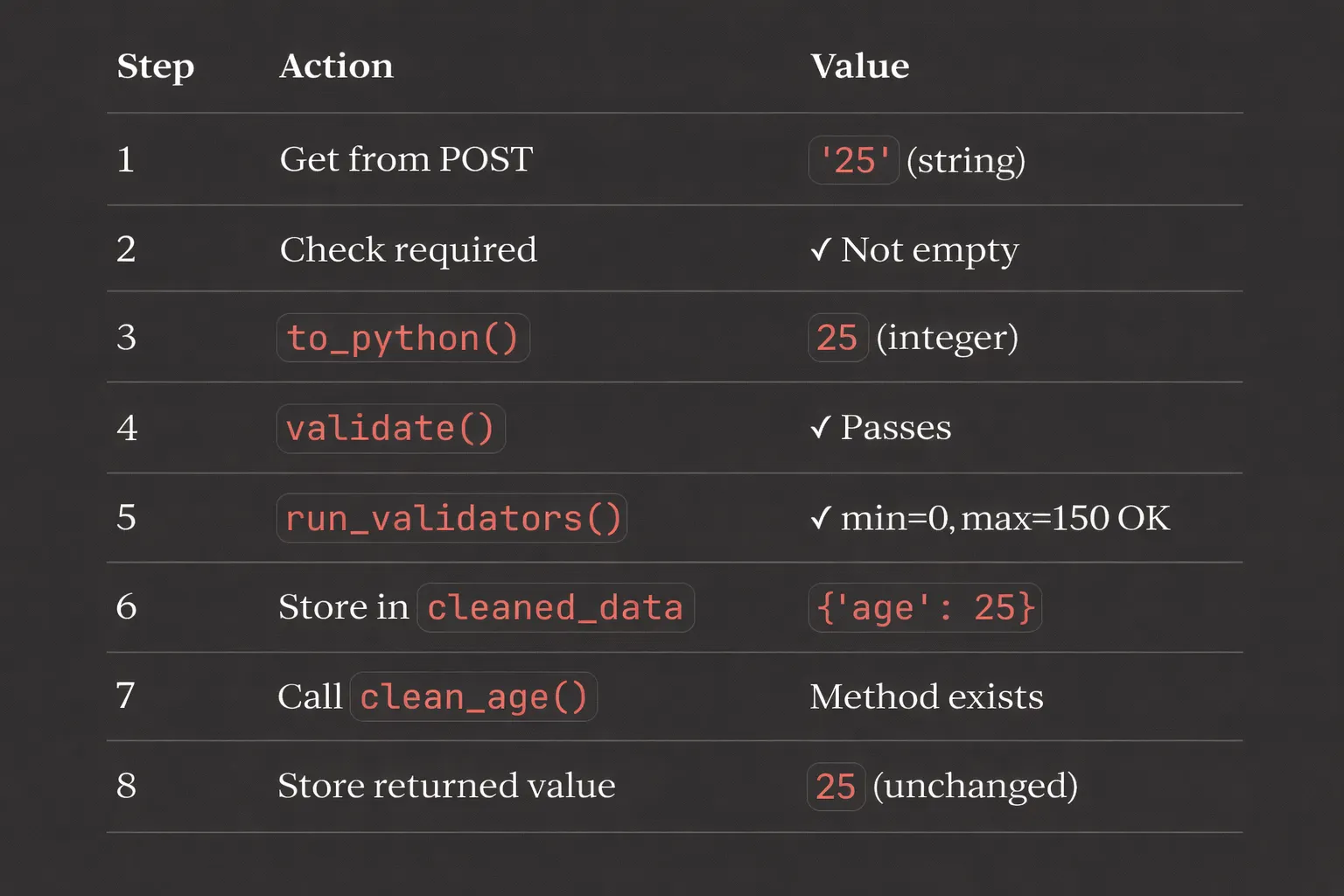
Let’s trace a single field through this:
class MyForm(forms.Form):
    age = forms.IntegerField(min_value=0, max_value=150)

    def clean_age(self):
        age = self.cleaned_data['age']
        if age < 18:
            raise ValidationError("Must be 18 or older")
        return age

# POST: {'age': '25'}
Steps 9–12: Form Cleaning (_clean_form)
def _clean_form(self):
    try:
        # Step 9: Call self.clean()
        cleaned_data = self.clean()
    except ValidationError as e:
        # Step 10: Handle ValidationError
        self.add_error(None, e)  # None = non-field error
    else:
        # Step 11: Update cleaned_data if clean() returned something
        if cleaned_data is not None:
            self.cleaned_data = cleaned_data
    # Step 12: Validation complete
The clean() method is for cross-field validation:
class RegistrationForm(forms.Form):
    password = forms.CharField()
    confirm_password = forms.CharField()

    def clean(self):
        cleaned_data = super().clean()
        password = cleaned_data.get('password')
        confirm = cleaned_data.get('confirm_password')

        if password and confirm and password != confirm:
            raise ValidationError("Passwords don't match")

        return cleaned_data
Steps 13–14: Post-Clean (_post_clean)
def _post_clean(self):
    # Step 13: Hook for subclasses (does nothing in Form)
    pass
    # Step 14: ModelForm uses this for model validation
For ModelForm, this is where model validation runs:
# django/forms/models.py
class BaseModelForm(BaseForm):
    def _post_clean(self):
        # Step 13: Apply cleaned_data to model instance
        try:
            self.instance = construct_instance(
                self, self.instance, self._meta.fields, self._meta.exclude
            )
        except ValidationError as e:
            self._update_errors(e)

        # Step 14: Run model's full_clean()
        try:
            self.instance.full_clean(exclude=exclude, validate_unique=False)
        except ValidationError as e:
            self._update_errors(e)
Why clean_fieldname Didn’t Run
This is the most common confusion. clean_fieldname() only runs if:
- The field passed all previous validation steps
- No ValidationError was raised during steps 2–5
class MyForm(forms.Form):
    email = forms.EmailField()

    def clean_email(self):
        print("This runs!")  # Only if email is valid
        return self.cleaned_data['email']

# If email is "not-an-email", clean_email() never runs
# The field fails at step 4 (validate) before reaching step 7
The pipeline short-circuits on error:
try:
    value = field.to_python(value)     # Might fail
    field.validate(value)              # Might fail
    field.run_validators(value)        # Might fail
    self.cleaned_data[name] = value

    if hasattr(self, f'clean_{name}'):
        value = getattr(self, f'clean_{name}')()  # Only reached if above succeeded
except ValidationError as e:
    self.add_error(name, e)
    # Skip clean_fieldname() for this field
Field Internals: to_python, validate, validators
to_python: Type Coercion
Converts raw string input to Python type:
# django/forms/fields.py
class IntegerField(Field):
    def to_python(self, value):
        if value in self.empty_values:
            return None

        try:
            value = int(str(value))
        except (ValueError, TypeError):
            raise ValidationError(
                self.error_messages['invalid'],
                code='invalid',
            )
        return value
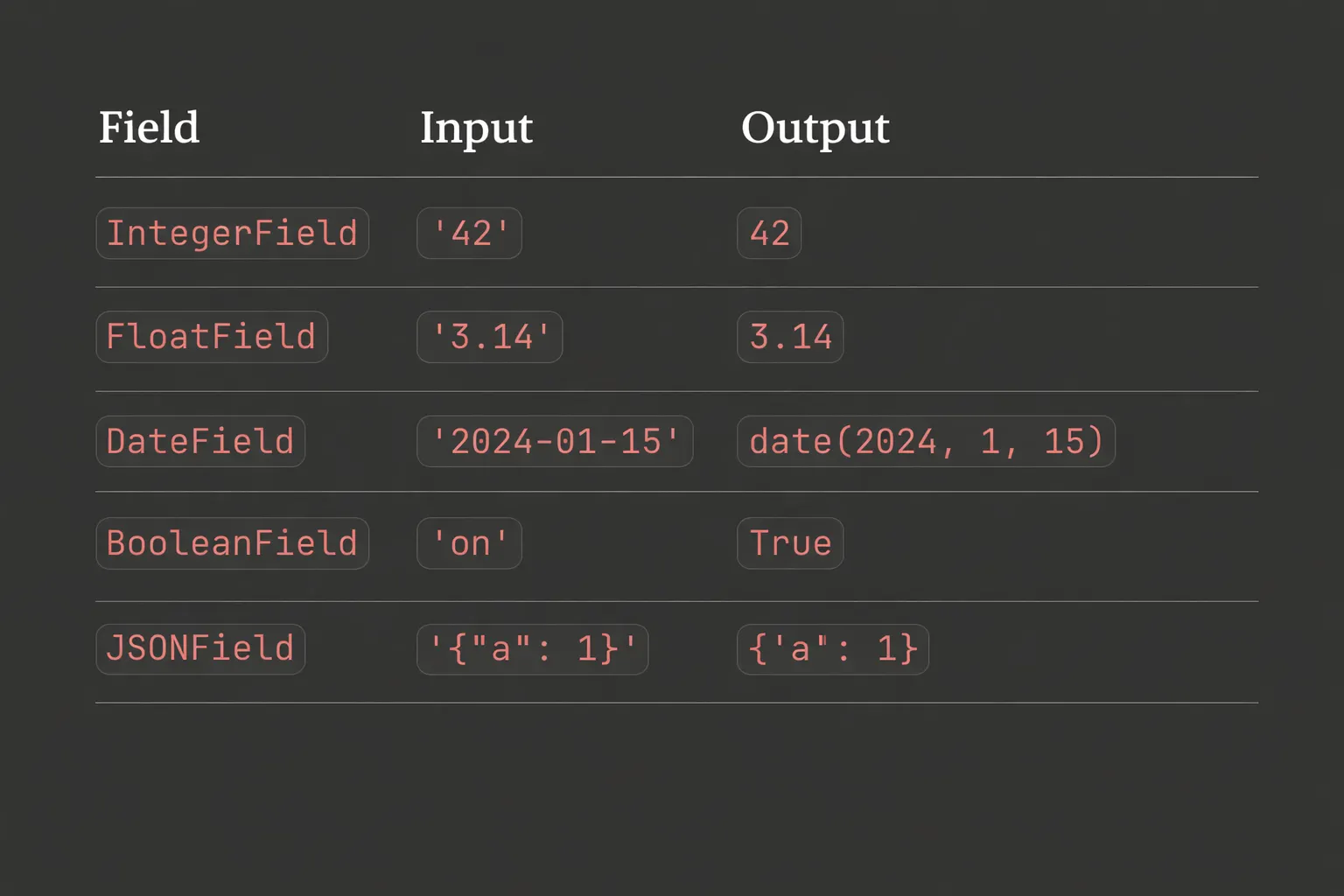
Each field type has its own coercion:
validate: Field-Specific Rules
Built-in validation that runs after coercion:
class EmailField(CharField):
    def validate(self, value):
        super().validate(value)  # CharField validation

        if value and not email_re.match(value):
            raise ValidationError(
                self.error_messages['invalid'],
                code='invalid',
            )
validators: The Validators List
from django.core.validators import MinValueValidator, MaxValueValidator

class IntegerField(Field):
    def __init__(self, *, min_value=None, max_value=None, **kwargs):
        super().__init__(**kwargs)

        if min_value is not None:
            self.validators.append(MinValueValidator(min_value))
        if max_value is not None:
            self.validators.append(MaxValueValidator(max_value))
Validators are callable objects:
# django/core/validators.py
class MinValueValidator:
    def __init__(self, limit_value, message=None):
        self.limit_value = limit_value

    def __call__(self, value):
        if value < self.limit_value:
            raise ValidationError(
                f'Ensure this value is greater than or equal to {self.limit_value}.'
            )
Executed by run_validators():
def run_validators(self, value):
    errors = []
    for validator in self.validators:
        try:
            validator(value)
        except ValidationError as e:
            errors.extend(e.error_list)

    if errors:
        raise ValidationError(errors)
Note: All validators run, even if earlier ones fail. Errors accumulate.
Error Handling: Where Errors Go
def add_error(self, field, error):
    if field is None:
        # Non-field error (form-level)
        self._errors.setdefault('__all__', ErrorList()).extend(error)
    else:
        # Field-specific error
        self._errors.setdefault(field, ErrorList()).extend(error)

        # Remove from cleaned_data if present
        if field in self.cleaned_data:
            del self.cleaned_data[field]
Three places errors can live:
form.errors['email']      # Field-specific errors
form.errors['__all__']    # Non-field errors (form.clean())
form.non_field_errors()   # Same as form.errors.get('__all__', [])
ErrorDict and ErrorList
# django/forms/utils.py
class ErrorDict(dict):
    """A dict that renders as HTML <ul>."""

    def as_ul(self):
        return format_html_join(
            '', '<li>{}{}</li>',
            ((k, v.as_ul()) for k, v in self.items())
        )

class ErrorList(list):
    """A list that renders as HTML."""

    def as_ul(self):
        return format_html(
            '<ul class="errorlist">{}</ul>',
            format_html_join('', '<li>{}</li>', ((e,) for e in self))
        )
In templates:
{{ form.errors }}           <!-- ErrorDict.as_ul() -->
{{ form.email.errors }}     <!-- ErrorList.as_ul() -->
{{ form.non_field_errors }} <!-- ErrorList.as_ul() -->
ModelForm: The Model Connection
class ArticleForm(forms.ModelForm):
    class Meta:
        model = Article
        fields = ['title', 'content', 'published']
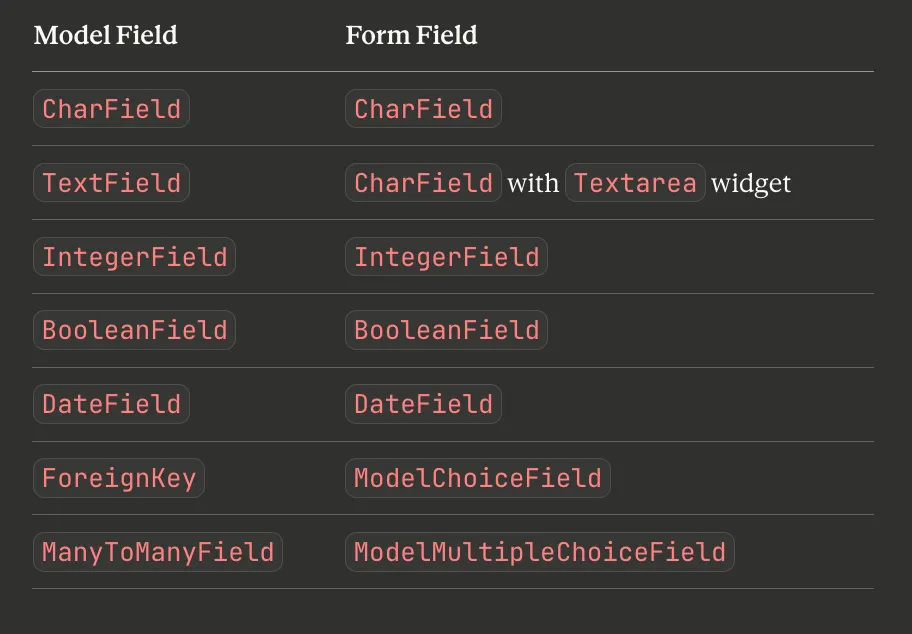
ModelForm generates fields from model fields:
# django/forms/models.py
def fields_for_model(model, fields=None, exclude=None, ...):
    field_dict = {}

    for f in model._meta.get_fields():
        if not isinstance(f, ModelField):
            continue

        if fields is not None and f.name not in fields:
            continue

        if exclude and f.name in exclude:
            continue

        # Convert model field to form field
        form_field = f.formfield()  # Each model field knows its form equivalent

        if form_field:
            field_dict[f.name] = form_field

    return field_dict
Model Field to Form Field Mapping
# django/db/models/fields/__init__.py
class CharField(Field):
    def formfield(self, **kwargs):
        defaults = {'max_length': self.max_length}
        defaults.update(kwargs)
        return forms.CharField(**defaults)

class IntegerField(Field):
    def formfield(self, **kwargs):
        return forms.IntegerField(**kwargs)

class ForeignKey(RelatedField):
    def formfield(self, **kwargs):
        return forms.ModelChoiceField(
            queryset=self.related_model._default_manager.all(),
            **kwargs
        )
save(): Creating or Updating
# django/forms/models.py
class BaseModelForm(BaseForm):
    def __init__(self, data=None, instance=None, ...):
        self.instance = instance or self._meta.model()

    def save(self, commit=True):
        # Apply cleaned_data to instance
        for name, value in self.cleaned_data.items():
            setattr(self.instance, name, value)

        if commit:
            self.instance.save()
            self._save_m2m()  # Handle many-to-many
        else:
            # Caller must save and call save_m2m() later
            self.save_m2m = self._save_m2m

        return self.instance
The commit=False pattern:
form = ArticleForm(request.POST)
if form.is_valid():
    article = form.save(commit=False)
    article.author = request.user  # Set additional fields
    article.save()
    form.save_m2m()  # Don't forget M2M!
Widget System: Rendering Fields
Each field has a widget for HTML rendering:
class CharField(Field):
    widget = TextInput  # Default widget

class EmailField(CharField):
    widget = EmailInput

class BooleanField(Field):
    widget = CheckboxInput
Widgets handle rendering and value extraction:
# django/forms/widgets.py
class TextInput(Input):
    input_type = 'text'

    def render(self, name, value, attrs=None):
        return format_html(
            '<input type="{}" name="{}" value="{}"{}>',
            self.input_type,
            name,
            value or '',
            flatatt(attrs),
        )

    def value_from_datadict(self, data, files, name):
        return data.get(name)
Custom Widgets
class DatePickerWidget(forms.DateInput):
    template_name = 'widgets/datepicker.html'

    def __init__(self, attrs=None):
        default_attrs = {'class': 'datepicker', 'autocomplete': 'off'}
        if attrs:
            default_attrs.update(attrs)
        super().__init__(attrs=default_attrs)

    class Media:
        css = {'all': ('css/datepicker.css',)}
        js = ('js/datepicker.js',)
FormSet: Multiple Forms
ArticleFormSet = forms.formset_factory(ArticleForm, extra=3)
formset = ArticleFormSet(request.POST)
FormSet manages multiple form instances:
# django/forms/formsets.py
class BaseFormSet:
    def __init__(self, data=None, ...):
        self.data = data or {}
        self.forms = []

        # Management form tracks total/initial/min/max
        self.management_form

    @property
    def forms(self):
        # Lazy form instantiation
        forms = []
        for i in range(self.total_form_count()):
            forms.append(self._construct_form(i))
        return forms

    def is_valid(self):
        # Validate all forms
        return all(form.is_valid() for form in self.forms)
The management form:
<input type="hidden" name="form-TOTAL_FORMS" value="3">
<input type="hidden" name="form-INITIAL_FORMS" value="0">
<input type="hidden" name="form-MIN_NUM_FORMS" value="0">
<input type="hidden" name="form-MAX_NUM_FORMS" value="1000">
Common Gotchas
Gotcha 1: cleaned_data Missing Keys
def clean(self):
    password = self.cleaned_data['password']  # KeyError!
If password field failed validation, it's not in cleaned_data.
Fix: Use .get()
def clean(self):
    password = self.cleaned_data.get('password')
    if password:
        # Process
Gotcha 2: clean_fieldname Must Return Value
def clean_email(self):
    email = self.cleaned_data['email']
    if User.objects.filter(email=email).exists():
        raise ValidationError("Email taken")
    # Forgot to return! cleaned_data['email'] becomes None
Fix: Always return
def clean_email(self):
    email = self.cleaned_data['email']
    if User.objects.filter(email=email).exists():
        raise ValidationError("Email taken")
    return email  # Don't forget!
Gotcha 3: Validation Order
Fields validate in declaration order:
class MyForm(forms.Form):
    first = forms.CharField()
    second = forms.CharField()

    def clean_second(self):
        # self.cleaned_data['first'] exists here
        # (if first field passed validation)
        return self.cleaned_data['second']
But in clean(), all fields are already processed:
def clean(self):
    # Access any field from cleaned_data
    # (if they passed validation)
Gotcha 4: BooleanField Required
class MyForm(forms.Form):
    agree = forms.BooleanField()  # required=True by default!
Unchecked checkbox = field not in POST data = fails required validation.
Fix: required=False or NullBooleanField
agree = forms.BooleanField(required=False)
What’s Next
This was the form and validation pipeline — 14 steps from POST to Python.
Next in the series: Authentication Backend Chain — how Django authenticates users, the backend resolution order, session mechanics, and why custom backends sometimes don’t work.
Series: Django Under the Hood
- Request Lifecycle
- ORM Query Compiler
- Connection Management
- Signal Dispatch
- Template Engine
- Form and Validation Pipeline ← You are here
- Authentication Chain
- Static Files
- Migration System
- Test Client